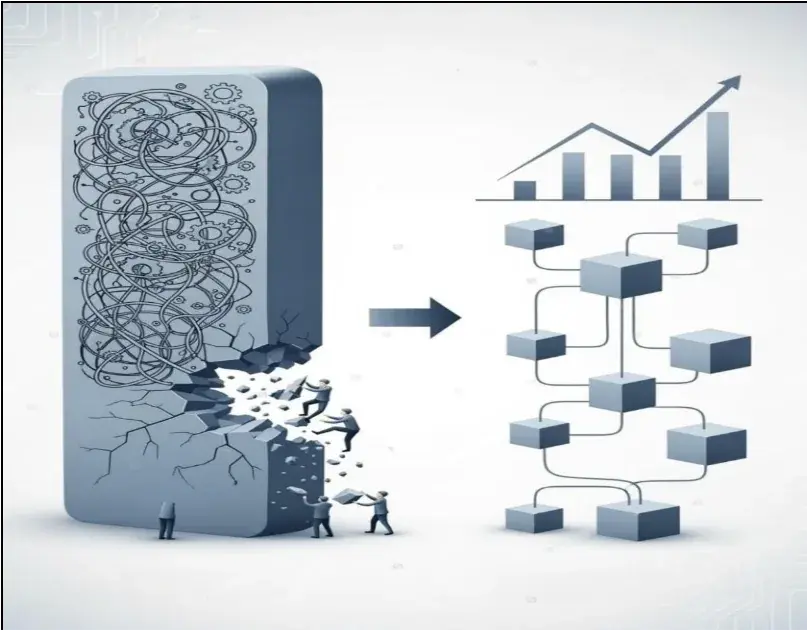





You've made the decision to break free from your monolithic architecture and embrace microservices. But here's where most organizations stumble - the attempt to achieve an overnight system overhaul could easily result in unexpected project failures and budget overruns!
The secret to successful microservices migration isn't speed; it's adopting a scalable and incremental migration strategy that enables seamless transformation of your architecture while keeping your business running smoothly.
What is a Scalable Approach to Microservices Migration?
Scalable approach amounts to gradually scaling your monolith into independent, loosely coupled services in an incremental and systematic fashion - not through a risky ‘big bang’ rewrite.
Core principles:
- Incremental decomposition: Extract one service at a time based on business value and technical feasibility
- Parallel operation: Run your monolith alongside new microservices during the transition period
- Zero business disruption: Maintain full operational capability throughout the entire migration journey
- Continuous validation: Test, optimize, and stabilize each microservice before moving to the next
- Team enablement: Allow developers to build cloud-native expertise progressively
This is akin to renovating a house while living in it - you upgrade room by room, ensuring functionality at every step, rather than demolishing everything at once.
How Scalable Migration Outperforms Big Bang Rewrites
Dramatically Reduces Business Risk
Over 70% of large-scale IT transformation projects either fail or suffer budget bleed. A scalable migration strategy minimizes this risk by:
- Limiting failure impact to individual services, not your entire system
- Enabling quick rollbacks without affecting critical business operations
- Providing regular validation checkpoints for stakeholder confidence
- Allowing real-world testing with actual production traffic before full commitment
Delivers Continuous Business Value
Scalable migration facilitates well-targeted, piecemeal-microservices development that enables quick deployment via agile sprints, delivering measurable results:
- Deploy high-priority features faster as independent microservices
- Address critical pain points immediately without waiting for full migration
- Generate ROI throughout the transformation, not just at the end
- Demonstrate tangible progress with working software that improves business metrics
Builds Technical Expertise Organically
Microservices development demands new skills - container orchestration, service mesh management, distributed tracing, and API gateway configuration. Gradual migration allows your team to:
- Develop expertise incrementally with each service extraction
- Learn from mistakes in controlled, low-risk environments
- Establish reusable patterns and best practices
- Create institutional knowledge that guides future development
Strategic Advantages of Scalable Microservices Migration
Superior Scalability and Performance Optimization
Microservices architecture unlocks scaling capabilities that are impossible with monolithic systems:
- Independent scaling: Scale only high-demand services rather than your entire application
- Resource optimization: Allocate infrastructure precisely where needed, reducing cloud costs
- Performance isolation: Prevent resource-intensive operations from degrading overall system performance
- Technology flexibility: Choose the optimal tech stack for each service's specific requirements
- Geographic distribution: Deploy services closer to users for reduced latency
Accelerated Development Velocity
Modern businesses compete on speed. Microservices enable the following:
- Parallel development: Multiple teams can build different services simultaneously without code conflicts
- True continuous delivery: Ability to implement real CI/CD pipelines for instant feature deployment
- Faster debugging: Isolate and resolve issues quickly with clear service boundaries
- Simplified testing: Validate smaller, focused codebases more efficiently and thoroughly
- Rapid deployment cycles: Deploy individual services multiple times daily with zero system downtime
Enhanced System Resilience
In monolithic architectures, a single bug can bring down your entire application. Microservices provide:
- Failure containment: Issues in one service don't cascade across your system
- Graceful degradation: Maintain operations with reduced functionality when services fail
- Quick recovery: Restart individual services without full system outages
- Circuit breaker patterns: Automatically isolate failing services to protect system health
- Granular monitoring: Gain precise visibility into each service's performance metrics
Organizational Agility and Innovation
Microservices transform not just your technology, but your entire organization:
- Team autonomy: Small, cross-functional teams own services end-to-end
- Technology evolution: Adopt new frameworks without rewriting your entire application
- Reduced dependencies: Accelerate decision-making by eliminating approval bottlenecks
- Innovation enablement: Safely experiment with new features in isolated services
- Developer satisfaction: Attract and retain top talent who prefer modern architectures
Essential Elements for Successful Scalable Migration
Strategic Service Decomposition
Effective migration starts with proper service boundary definitions:
- Apply domain-driven design to identify bounded contexts representing distinct business capabilities
- Define clear API contracts and service interfaces
- Establish data ownership patterns to avoid database sharing
- Map dependencies to minimize coupling between services
Infrastructure Foundation
Build the technical platform that supports microservices:
- Deploy container orchestration platforms like Kubernetes for service management
- Implement API gateways for routing, security, and traffic management
- Establish centralized logging and distributed tracing for observability
- Create automated CI/CD pipelines for each independent service
Strangler Fig Pattern
Use this proven migration pattern for seamless transitions:
- Introduce at the start, a proxy that enables request routing to the legacy system
- Re-route through the proxy, specific functionality, as new microservices get built while maintaining the monolith
- Gradually extract more capabilities as services demonstrate better stability
- Eventually decommission legacy components when migration completes
- Ensure business continuity throughout the entire transformation
Best Practices for Migration Success
Choose Your First Service Wisely
Your initial microservice extraction sets the foundation for everything that follows. Select a service that is:
- Sure to deliver clear business value and carries the ability to demonstrate quick wins to stakeholders
- Has minimal dependencies on other system components
- Represents manageable complexity for your team's current skill level
- Provides valuable learning opportunities without excessive risk
Prioritize Observability
Comprehensive monitoring is non-negotiable for distributed systems:
- Implement distributed tracing to understand cross-service interactions
- Centralize log aggregation for efficient troubleshooting
- Track real-time performance metrics with automated alerting
- Monitor business KPIs to measure transformation success
Address Data Management Complexity
Data architecture is often the most challenging aspect of migration:
- Define clear data ownership for each microservice
- Use event-driven patterns for cross-service data synchronization
- Accept eventual consistency where real-time consistency isn't required
- Plan migration strategies for existing data during service extraction
Transform Your Architecture the Right Way
A scalable, incremental approach to microservices migration reduces risk, delivers continuous value, and positions your organization for long-term digital success. Start strategically, learn continuously, and scale your migration as your expertise grows.
Ready to modernize your architecture without the risk? Partner with experienced cloud architects to design your customized microservices migration roadmap and accelerate your digital transformation today.