%20Announces%20Top%2040%20Innovative%20Co%201.svg)
ivoyant named to Georgia's Top 40 Innovative Companies 2026.

ivoyant named to TAG TOP40


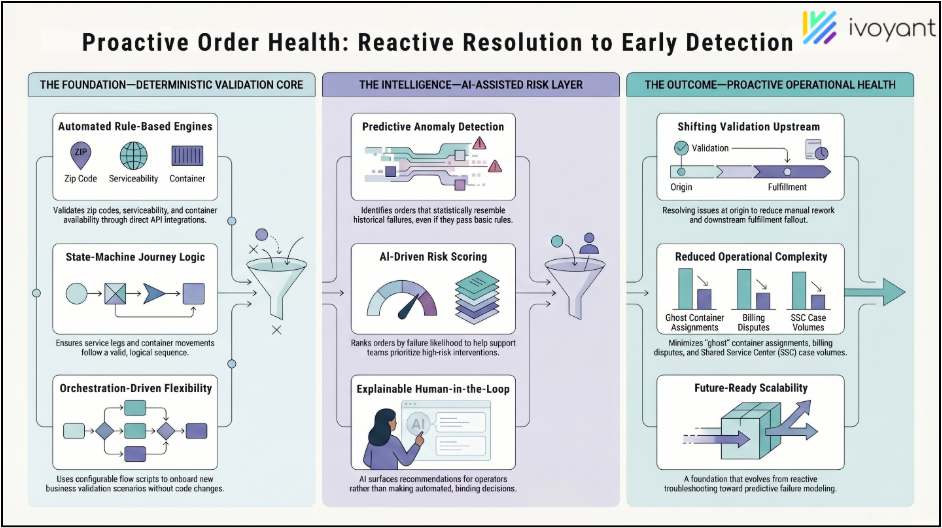
In enterprise logistics, the most expensive operational failures are rarely surprises. They are predictable patterns hiding inside data the business already has, waiting for someone, or something, to notice them in time.
That observation sits at the heart of a recent ivoyant engagement with a leading provider of portable storage and moving solutions. ivoyant has designed and implemented a dynamic, AI-augmented order validation framework that pairs rigorous rule-based validation with risk intelligence capabilities. It is built to grow with the business, onboarding new validation scenarios as they emerge rather than locking the client into a fixed set of checks.
EXECUTIVE SUMMARY
ivoyant has designed and implemented a dynamic, AI-augmented order validation framework for a leading portable storage and moving solutions provider, built to detect order issues proactively, shortly after booking, before they cascade into fulfillment failures, billing discrepancies, scheduling conflicts, or customer escalations.
At its core, the framework runs a configurable validation engine driven by rule logic, API integrations, and a state-machine model of valid service leg journeys. It addresses high-impact validation scenarios like service area validation, calendar availability validation, and service leg sequence validation. However, the framework is not limited to these. Its dynamic configuration model allows business users to onboard new validation scenarios on demand, as new process needs emerge.
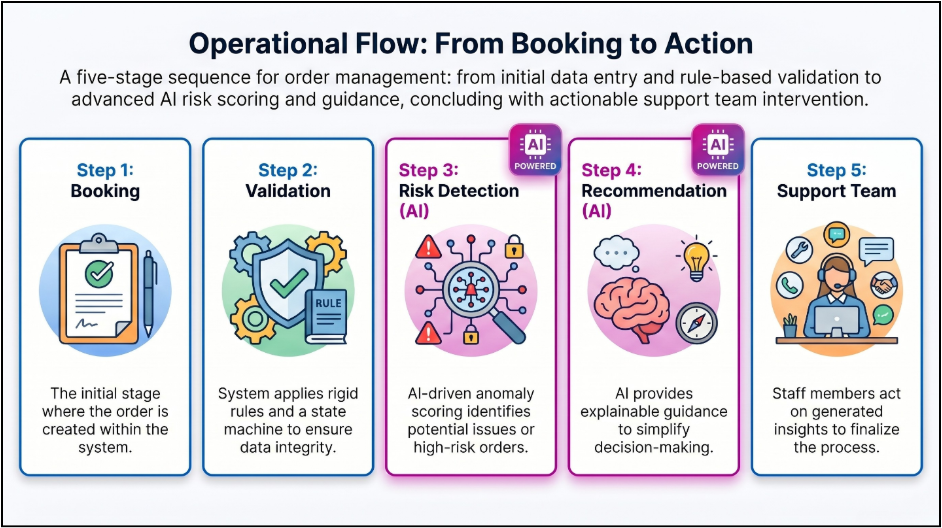
Above this core, an AI-assisted risk intelligence module learns from historical order outcomes to score risk, surface anomalies, and generate explainable recommendations for support teams. Explainability and human-in-the-loop oversight are non-negotiable design principles.
Iterative delivery approach: The framework was delivered iteratively, with the initial validation scenarios in production and the architecture designed to absorb additional scenarios and AI-assisted intelligence capabilities as the business evolves.
BACKGROUND: WHY ORDER QUALITY MATTERS AT SCALE
The client's orders flow through a complex ecosystem of enterprise systems spanning CPQ, ERP, route management, dispatch, container management, and warehouse operations. Each system contributes to a specific stage of the order lifecycle, but the seams between them create predictable validation gaps.
An order in the client's environment is not a single record. It is a header plus multiple service leg lines, each representing a physical container movement event: Initial Delivery (IDEL), Warehouse Return (WRT), Inter-Franchise Transit (WTW), Redelivery (RDL), or Final Pickup (FPU). Their combinations derive distinct journeys: Storage Onsite, Storage Warehouse, Local Move, Inter-Franchise Move, Self Delivery and Pickup, City Service, and several hybrids.
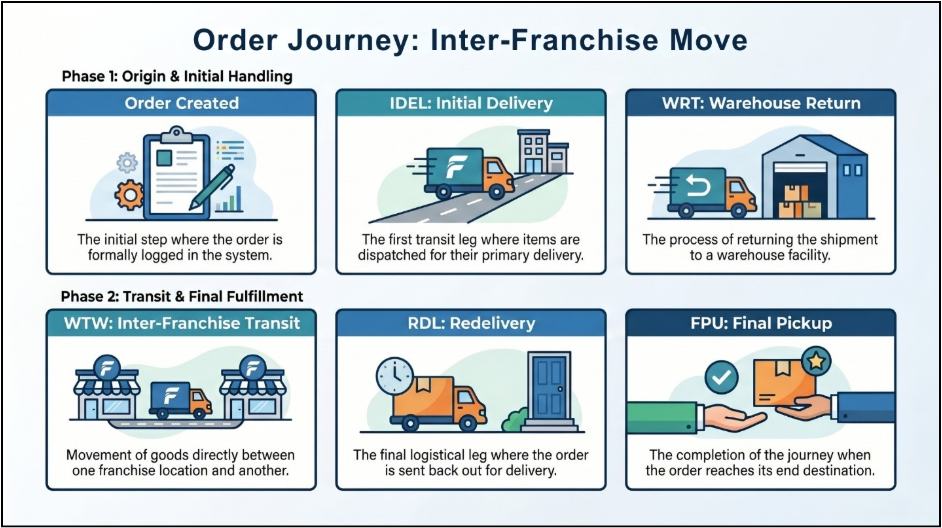
When the data, sequencing, or configuration of any leg is incorrect, the consequences translate into missed pickups, billing disputes, ghost container assignments, manual rework, and erosion of customer trust.
CLIENT CHALLENGES
ivoyant's discovery work surfaced a recurring pattern: most operational failures the client was absorbing were not novel. They were detectable issues that simply went undetected until they reached the customer.
The specific challenges shaping the engagement
The strategic question was not whether to automate, but how to shift validation upstream in a way that was explainable, governable, and operationally trusted.
THE SOLUTION: A LAYERED VALIDATION ARCHITECTURE
The framework is built around a deliberate choice: get the deterministic foundations right first, then layer AI on top where it adds real signal. This protects operational trust and gives operators a system they can understand from day one.
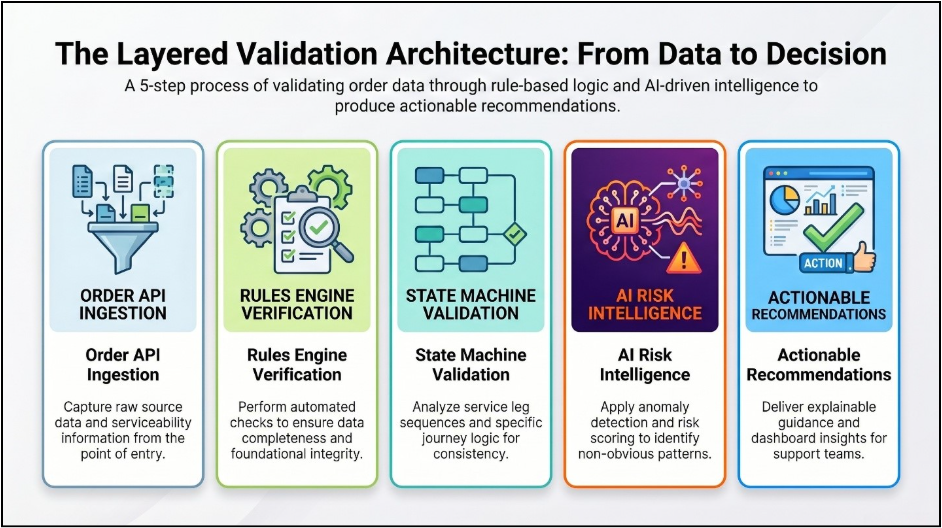
Layer 1: Deterministic Validation Core
The base is a structured validation engine that does not rely on AI.
Every outcome traces to a specific rule, API response, or decision-table entry, with no black-box decisions reaching operations.
A Dynamic, Orchestration-Driven Framework
What makes the deterministic core powerful is not just what it validates today, but how easily it accepts new validations tomorrow. The framework is engineered as a configurable engine rather than a fixed set of checks. It is designed to grow and scale up as new validation scenarios based on growing business requirements keep coming.
Validation logic is defined through a process orchestration flow script: a structured, visual specification of decision points, conditions, API calls, and outcomes. When a new business process or validation need surfaces, business and operations teams can model it in the same way, and the engine executes it without code changes to the platform itself.
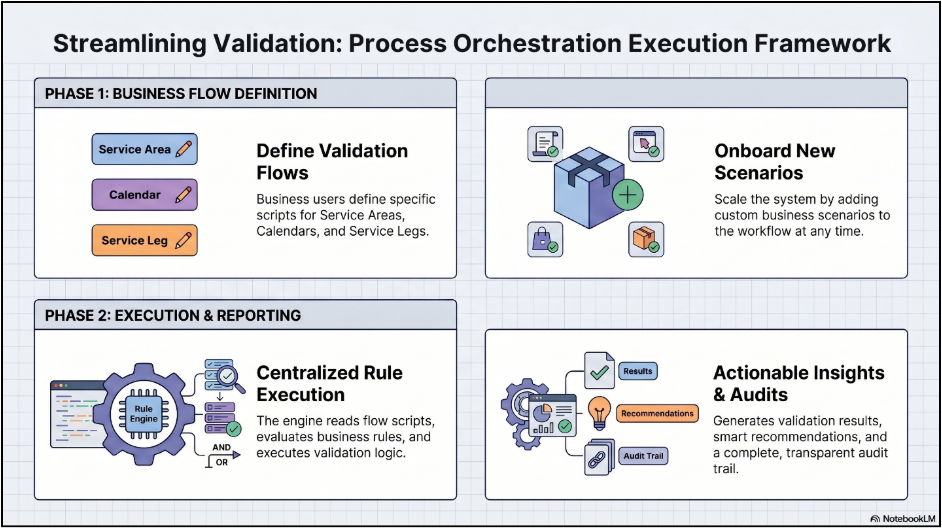
This is what makes the solution genuinely scalable. Instead of validating a static checklist, the framework grows with the operating model: new journey types, new compliance checks, new exception handling, new business rules, all added without reopening the platform.
Layer 2: AI-Assisted Risk Intelligence
Above the core sits an AI-assisted layer that addresses what rules cannot: emerging risk patterns and which issues warrant attention.
The AI layer never makes binding decisions. It augments operators with prioritisation and pattern intelligence rules cannot produce.
Validation Scenarios in Production
Three high-impact validation scenarios are live in the framework today, each surfacing issues at booking. The architecture is designed so additional scenarios can be modelled and onboarded by business users as new validation needs emerge.
Each scenario runs across all client journey types. Validated orders flow into the AI-assisted layer, which ranks them by failure likelihood and surfaces recommendations for Production Support, SSC Operations, and front-line agents.
SOLUTION HIGHLIGHTS
THE TAKEAWAYS
With validation scenarios live in production, the framework delivers measurable value across operational efficiency, customer experience, and team productivity.
CONCLUSION
Enterprise operations rarely fail because something dramatic happened. They fail because small, knowable issues went unnoticed until they were no longer small. The ivoyant Order Validation framework was built around that observation.
By combining a dynamic deterministic core with an AI-assisted risk intelligence layer, ivoyant has helped the client move from reactive issue resolution to proactive order health validation. Rules catch the knowable issues with full traceability. AI surfaces emerging patterns and prioritises where to look first. And the process orchestration flow model ensures the framework expands as the business does, not as engineering schedules allow.
Real operational intelligence does not come from labelling everything AI. It comes from engineering disciplined validation into the systems that shape the business, applying AI where it adds signal rules cannot produce.
For organizations grappling with multi-system order ecosystems, complex fulfillment patterns, and rising operational complexity, the lesson generalizes. The opportunity is not to automate further. It is to validate earlier.
Let's talk. If your enterprise is dealing with multi-system order flows, fulfillment fallout, or rising support volumes, ivoyant's order validation framework can be tailored to your environment. Connect with us to explore where proactive validation could unlock value.
.png)
.png)
.png)
.png)
.png)

%201.svg)